

Noah Baumbach’s newest film Jay Kelly arrives as one of his most delicate and introspective works, and that’s saying a lot for a filmmaker who has built an entire career on turning emotional nuance into cinematic art. But Jay Kelly adds a twist that feels almost mischievous: its star is George Clooney, playing a fictional actor whose career bears a striking resemblance to Clooney’s own. It’s a role that allows Clooney to peel back layers of celebrity, memory and identity in a way that becomes unexpectedly raw. And at the center of the film lies one scene—one astonishing, meta, deeply human scene—that captures everything the movie wants to say about how we look back at our lives, and what it means to see ourselves clearly, perhaps for the first time.
Clooney plays Jay Kelly, a beloved, slightly enigmatic A-list actor whose decades-long career has made him recognizable across the world. Jay is polished, charming, and good at performing his own legend. But he hasn’t spent much time examining the emotional debris that has piled up behind the Hollywood façade. As the film opens, Jay is finishing the final scene of a movie he’s shooting, and he insists on doing it again. “Can I go again? I’d like another one,” he says—an innocuous request that will become a motif for the entire film. He’s not just chasing a better take; he’s chasing a better understanding of himself, a better grip on a life he’s moved through so quickly that he rarely stopped to breathe.
Baumbach then sends Jay on a journey across Europe, a physical and emotional pilgrimage that leads him to an Italian film festival where he’s meant to receive a lifetime achievement award. But the film isn’t about the award—it’s about what Jay learns on the way there. Through encounters with fans, colleagues, strangers on trains, and people from his past, he starts to see the quiet spaces between the big moments. He starts to notice where he hid, where he performed, where he pushed people away, and where he tried to love but didn’t quite know how.
By the time Jay arrives at the festival, he’s been stripped down emotionally in ways he wasn’t prepared for. And that’s precisely when the movie delivers its unforgettable closing moment.
During the ceremony, the festival unveils a tribute reel celebrating Jay Kelly’s career. But instead of fictional clips or manufactured scenes, Baumbach crafted a montage of George Clooney’s real-life work. Early TV roles like Combat Academy and Sunset Beat, the breakout fame of ER, acclaimed films like Syriana, and other recognizable highlights from Clooney’s decades on screen. The tribute is for Jay, but the footage is pure Clooney—and that means the man sitting in the audience isn’t just watching a character’s life. He’s watching his own.
And Clooney wasn’t told this would happen.
He recounts it almost like a prank—clever, slightly disorienting, and executed with the perfect amount of Baumbach mischief. “Imagine this,” he says with a wry smile. “We took it to the Venice Film Festival. So we’re at an Italian film festival watching myself watch myself at an Italian film festival.” It sounds like a joke, but beneath the humor is something much more vulnerable. “I didn’t know he was going to use clips from my real films,” Clooney admits. “I didn’t know that was what was coming up. So the take in the movie is the first take when I’m watching.”
Baumbach clarifies the moment with affectionate teasing. “I mean, it was always in the script. I think he probably just lived in some form of denial,” he says, laughing. He explains that while filming, he quietly assembled the montage on the side, knowing full well he wasn’t going to show it to Clooney beforehand. The entire plan hinged on authenticity. He wanted Clooney’s reaction—the real emotional surge—to become Jay Kelly’s reaction onscreen. “He allowed himself to be that vulnerable,” Baumbach says. “He’s having a real reaction watching his actual life go in front of him. That’s got to have an emotional effect on George Clooney.”
And it did. The tears that fall during the scene aren’t rehearsed. They aren’t crafted or polished. They’re the tears of a man who has lived 64 years, who has seen fame arrive fast and youth disappear quietly, who remembers the people he worked with, the nights he spent memorizing lines, the moments when his life was simpler or messier or just different. Clooney puts it simply: “When you’re 64 years old, everything’s emotional. When I see a movie, I remember the time I spent with the director or the actors. I don’t really see the movie as a movie. I see it as pieces of time.”
That phrase—pieces of time—echoes throughout the film. Baumbach uses it almost like a thesis statement. Jay Kelly isn’t about celebrity. It’s about how human beings make sense of themselves through memory, and how memories often feel like sharp, scattered fragments rather than smooth narratives. Watching the montage isn’t just Jay evaluating his career; it’s a man feeling the weight of his own chronology.

What makes the moment even more cinematic is how Baumbach frames Clooney’s face. He holds the shot long enough for us to witness the full evolution of emotion—the surprise, the quiet ache, the bittersweet realization that time has passed in ways he can’t rewind. And when the reel ends, Jay looks directly into the camera and repeats the line from the film’s opening: “Can I go again? I’d like another one.” Except this time, the line carries the heavy pulse of life itself. It’s no longer about acting. It’s about longing—for more time, for a chance to fix mistakes, for the possibility of reliving moments we didn’t fully understand when we had them.
Clooney’s co-star Billy Crudup, who appears in the festival audience during the scene, describes it as “extremely clever,” praising the layers of reference and the emotional resonance it creates. Crudup brings up an earlier line from the movie, when a fan tells Jay on a train, “When I look at you, I see my whole life.” It’s a line that captures how cinema functions in the lives of audiences. Movies become personal timestamps. They hold memories of who we were when we watched them, who we loved, what we were afraid of, what we were dreaming about. “For people who go to movies, enjoy movies, and have actors that they follow,” Crudup says, “it really is moving to see a reel like that.”
That’s why the ending works on two separate but deeply intertwined levels. For Jay Kelly, it’s a moment of clarity—one where he finally sees the entirety of his life, not through the haze of ego or performance, but through the simple, unflinching lens of time. For George Clooney, it’s something even more private: a reckoning with the reality of his own career, an emotional confrontation with decades of work that shaped him. And for the audience, it becomes a communal experience, a chance to reflect on how Clooney’s movies have woven themselves into pop culture and into individual lives.
There’s something almost sacred about watching someone watch themselves. It feels intimate, like reading over someone’s shoulder as they look through a scrapbook they forgot they made. And Clooney allows the audience into that vulnerability without hiding behind performance. He doesn’t try to play the moment cool or ironic. He settles into what he’s feeling and lets the camera see it.
That’s the heart of what makes Jay Kelly feel so different from other films about movie stars. It isn’t interested in glamour or scandal or the machinery of Hollywood. It’s interested in something far quieter: the interior life of someone who has spent decades being looked at, admired, imitated, and projected upon. It asks what happens when a man like that finally looks inward instead of outward.
And Baumbach’s choice to let Clooney confront his real career doesn’t feel like a gimmick. It feels like a gentle act of honesty. The film acknowledges that the boundary between actor and character is thin, sometimes invisible. Jay Kelly is not George Clooney, but the overlap between them creates something tender and truthful.
By the time the film ends, the audience is left with the same question Jay faces—how do any of us measure our lives? Through accomplishments? Through moments of love and loss? Through the people who shaped us? Through the memories we revisit when we think about who we’ve become?
Jay wants another take. Another chance. Another moment.
But the beauty of Jay Kelly is that it suggests the first take—the real one, messy and unplanned—is often the most honest. The montage isn’t a highlight reel of perfection; it’s a collection of memories, choices, and eras. And that’s what makes Clooney’s reaction so human. He isn’t watching greatness. He’s watching himself.
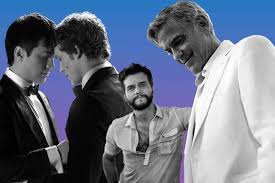
The film lingers on that feeling: the tenderness of remembering, the ache of realizing how quickly life moves, the humility of seeing one’s own journey without the filters of mythology. Clooney’s tears, quiet and unexpected, become the emotional climax of a film that’s built not on spectacle but on sincerity.
In the end, Jay Kelly becomes more than a story about a fictional actor. It becomes a mirror—for Jay, for Clooney, and for anyone who has ever looked back on their life and felt the bittersweet rush of time. It’s a movie about the stories we tell ourselves, the roles we play without realizing it, and the moments when life hands us a montage we didn’t ask for but needed to see.
And as Clooney sits there, in character yet fully himself, watching decades of his life flicker on a festival screen, he gives the audience a rare and unforgettable gift: permission to feel the same. Permission to look back, to feel everything, to smile at the absurdity, to mourn what’s gone, and to whisper, with both longing and gratitude—Can I go again? I’d like another one.